
Perimeter fence
Perimeter Dust Control
Misting points are arranged along likely escape paths and downwind boundaries.
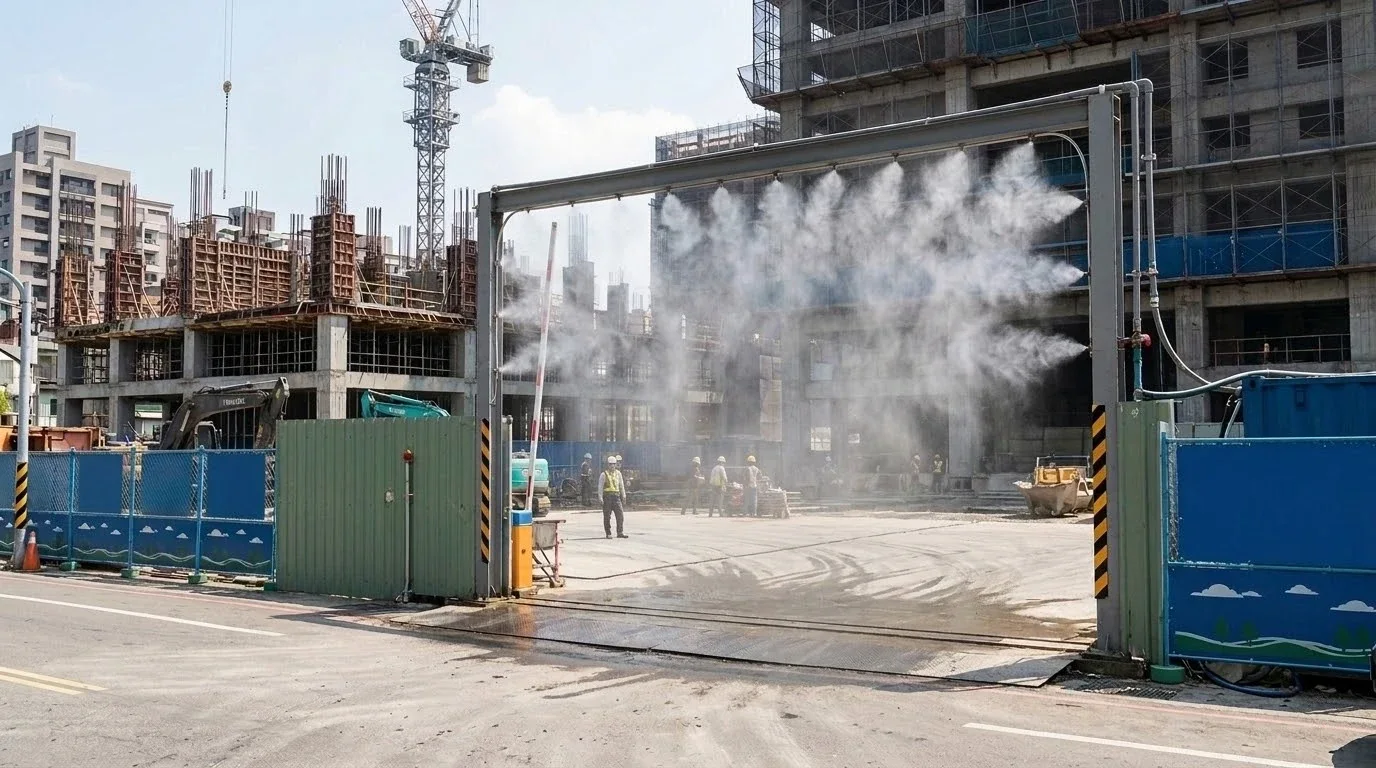
Yuan Tsai’s Smart Construction Environmental Management System is built around misting equipment, pump and filtration sets, piping, nozzles, and control systems. The layout is planned for site perimeters, entrances, dust-generating work zones, traffic routes, and heat-exposed areas, with optional integration of confirmed external environmental signals for zoned and automated operation.
Dust conditions change with excavation, demolition, unloading, vehicle movement, wind, and the construction schedule. Heat exposure also shifts by floor, shade, and work period. A fixed sprinkler or a single operating schedule rarely covers all conditions.
Large droplets wet the ground quickly but may not remain airborne long enough to interact with suspended dust. Overwatering can also create mud, slip hazards, and unnecessary water use.
The system is divided by actual operating zones so each area can use an appropriate nozzle type, pressure, installation height, and schedule.
Automation remains within a clearly defined misting-control interface. We can provide or reserve interfaces for timer schedules, zone valves, water-level protection, pressure protection, remote start/stop, and external sensor signals.
The standard package centers on misting and control systems; sensors, certified monitoring stations, AI cameras, CCTV systems, and cloud dashboards are integrated separately when required by the project.
Requirement review
Confirm the owner specification, work type, operating period, and expected treatment zones.
Site survey
Review dimensions, wind direction, dust sources, traffic, water, power, drainage, and installation access.
Zone and point planning
Define perimeter, entrance, source, and heat-mitigation zones.
Equipment selection
Select pump capacity, filtration, piping, nozzles, valves, and control method.
Proposal and quotation
State the included scope, optional interfaces, exclusions, and assumptions.
Installation
Complete equipment placement, piping, wiring, supports, and protection.
Testing and training
Test pressure, coverage, zoning, protections, and operating procedures.
Maintenance
Set filter, nozzle, valve, pump, and piping inspection intervals.
The following examples stay within Yuan Tsai’s actual misting scope: perimeter control, entrance dust suppression, demolition, earthwork, elevated work zones, and worker rest-area cooling. Each card can be browsed and enlarged.
Misting points are arranged along likely escape paths and downwind boundaries.
Treat vehicle-induced dust at the entry and exit without using one setting for the entire site.
Position misting close to the demolition face and adjust as the work front moves.
Use zoned coverage for excavation, loading, unloading, and exposed material.
Evaluate evaporation, wind, slip risk, and work activity before applying cooling mist.
Provide localized cooling where shade, airflow, drainage, and operating periods are controllable.
For factories, mines, crushers, conveyors, and material-processing facilities, see Industrial Dust & Odor Control.