Smart Farm Climate Control

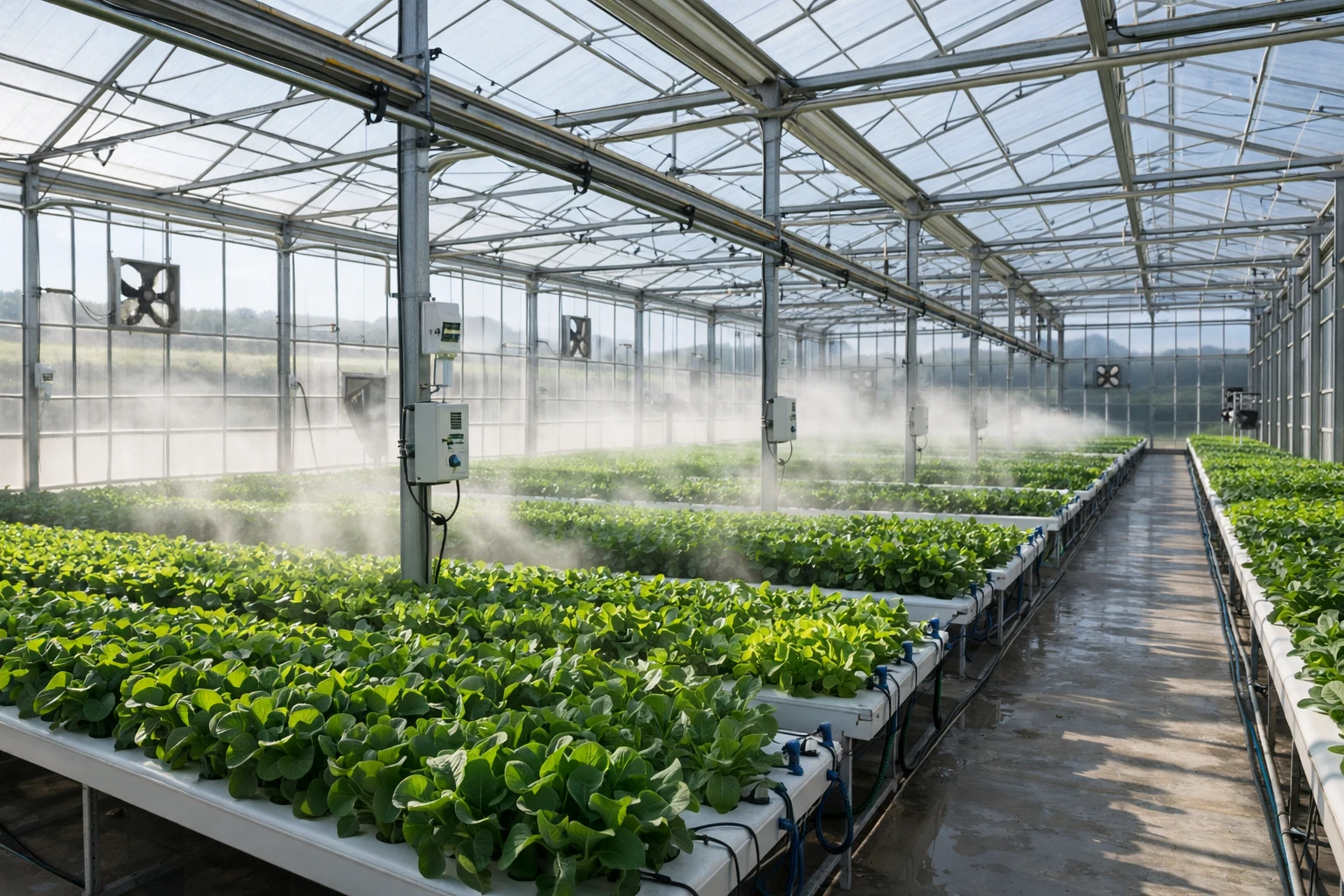
Smart agriculture climate control turnkey greenhouse system with misting and monitoring

Crop consistency depends on stable temperature, humidity, airflow, and radiation. We deliver turnkey greenhouse/farm climate control—misting, ventilation, sensing, and automation—so you can keep conditions stable with less labor.

What you get
  • More stable conditions to reduce heat and dryness shocks
  • Zonal control for different crops and areas
  • Data-ready operation for tuning and expansion
3-Step Process
Crop & facility audit
Confirm crop needs, greenhouse conditions, sensors and equipment
Turnkey climate design
Zoned mist/vent/cooling/humidification control logic
Go-live & calibration
Monitoring, parameter tuning, and SOP setup
Outcome Highlights
Stability
Reduced temperature/humidity swings (facility-dependent)
Automation-ready
Integrates with sensors and controllers
Resource efficiency
Zoned strategies for better water/energy use
Scalable
Phased expansion by zones or houses
Suitable for
  • Greenhouses, nurseries, leafy greens/herbs cultivation
  • Turnkey climate control for temperature/humidity/dust
  • Farms wanting monitoring automation and zoned control
Not recommended
  • Crops that should avoid leaf wetness (requires different strategy)
  • Cannot deploy piping/control wiring or lacks maintenance resources
  • Poor water/filtration causing frequent clogging

Why environments become unstable

Common causes are heat accumulation, humidity swings, and uneven airflow—leading to inconsistent growth and higher disease risk.

  • Heat stress at midday
  • Humidity too high (disease) or too low (dehydration)
  • Uneven zones within the same house

Turnkey architecture

We integrate “sense → control → execute” across misting, ventilation, shading, and circulation for consistent conditions.

  • Sensing: temp/humidity/wind/radiation (as needed)
  • Control: zone-based setpoints and automation
  • Execution: misting + fans + ventilation integration

Zonal control and sensing

Different zones require different strategies; zonal control avoids one setting harming part of the house.

  • Zone schedules by sun and time
  • Separate strategies for nursery/harvest zones
  • Operate only where needed to save resources

Modular and scalable design

Start with the highest-need areas and expand step by step without reworking the whole system.

  • Add zones and sensors over time
  • Standardized parts and maintenance
  • Upgrade path for future integrations

Long-term operation and data

We plan filtration, nozzle care, and operational logic so performance remains stable through seasons (site-dependent).

  • Maintenance cycles for filters and nozzles
  • Data review for strategy optimization
  • Seasonal curve adjustments

Representative Applications

Agricultural climate control varies by crop type and room condition. Seedlings, flowers, vegetables, mushrooms, and storage areas have different humidity and cooling priorities. Each card below has its own looping carousel and lightbox view.

Seedlings

Seedling Nursery Humidification

Maintains stable humidity around dense trays and nursery beds.
Floriculture

Flower Greenhouse Humidification

Supports more even moisture conditions for flower cultivation.

Vegetables

Vegetable Greenhouse Cooling

Helps stabilize greenhouse heat during hot seasons.

Mushrooms

Mushroom Growing Room Humidification

Better suited to enclosed or semi-enclosed growing rooms.

Storage

Agricultural Storage Humidification

Helps reduce dehydration and stabilize produce storage conditions.

FAQ

Is it suitable for hybrid greenhouse and open-field farms?
Yes. Control architectures can be designed for mixed site types and operating modes.
Does it support remote monitoring?
Yes. It supports remote environmental data monitoring and operational management.
Is it suitable for overseas replication?
Yes. Modular design supports international replication and rollout.
Can it be implemented in phases?
Yes. Deployment can be phased based on budget and priorities.
Does it improve crop stability?
It reduces environmental fluctuations and improves production consistency.