
Stone processing
Stone-Processing Dust Control
Treat cutting and material-handling dust close to the work area while checking wetting limits.
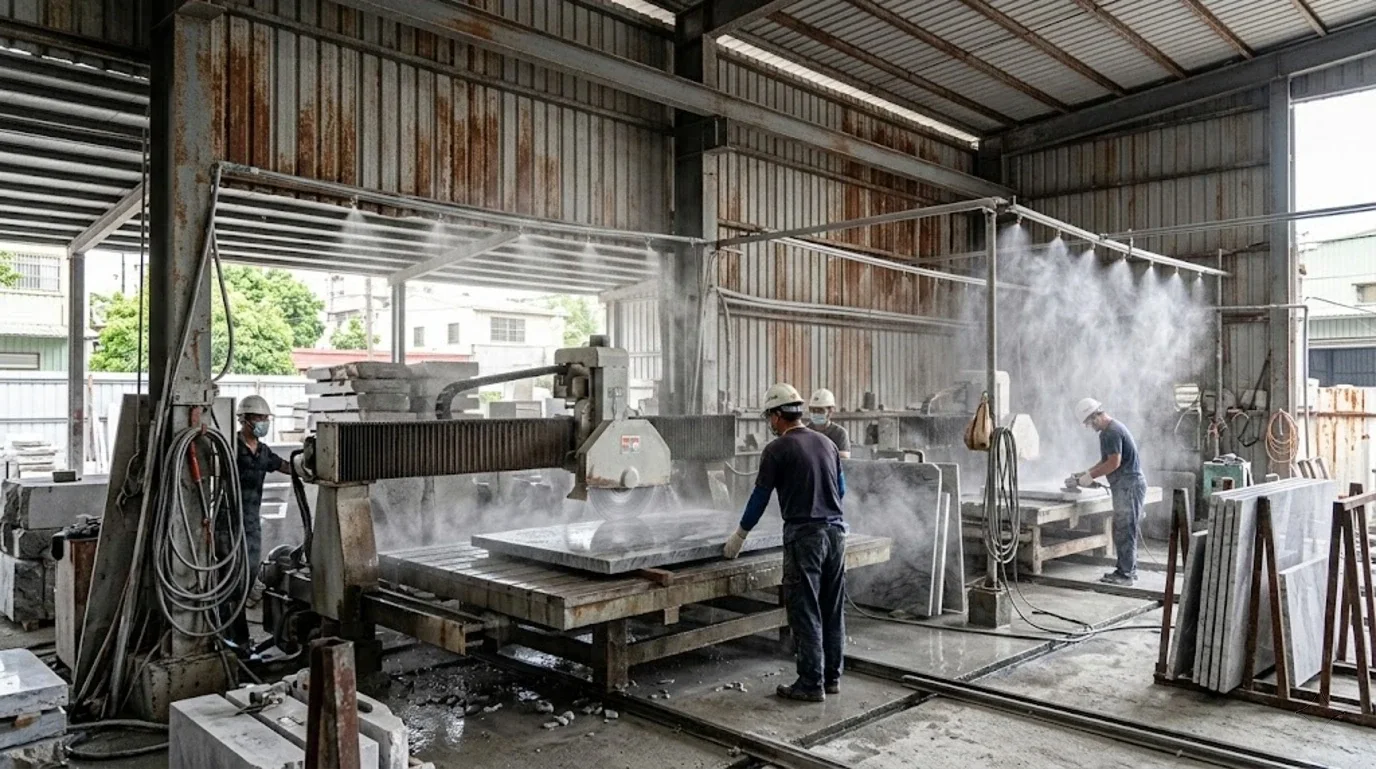
Industrial dust and odor problems usually originate from crushing, conveying, unloading, cutting, heat, exhaust, and material handling. Yuan Tsai evaluates the source and airflow path before configuring misting, zoning, and maintenance access for factories, mines, and material-processing sites.
The visible plume is often only the symptom. The actual cause may be a moving material stream, hot updraft, exhaust imbalance, crosswind, or repeated traffic through an open bay.
Large-volume spraying may create wet material, runoff, or housekeeping problems. Increasing ventilation without controlling the path may spread the contaminant to a larger area.
The primary approach is to treat dust close to its generation point and then manage likely escape paths. Odor treatment requires a separate review of the source, chemistry, airflow, and material compatibility.
Performance should be checked against project-specific indicators rather than a generic promise. Depending on the site, review items may include visible plume behavior, deposition, housekeeping, operator feedback, water use, pressure, and equipment condition.
Requirement review
Confirm the process, material, operating cycle, moisture limits, and expected control area.
Site survey
Review source locations, airflow, heat, traffic, access, water, power, drainage, and safety constraints.
Concept and testing plan
Select source points, zones, nozzle direction, pressure, and evaluation indicators.
Equipment and piping design
Size pump, filtration, piping, valves, supports, and controls.
Scope and quotation
State assumptions, exclusions, optional interfaces, and maintenance responsibility.
Installation and commissioning
Install, pressure-test, verify coverage, and train operators.
Review and adjustment
Adjust timing or point locations based on actual process behavior.
Maintenance
Inspect filters, nozzles, valves, pump, piping, and water quality.
These examples focus on factory and mining applications only, separating them from the construction-site solution. Each card can be browsed and enlarged.
Treat cutting and material-handling dust close to the work area while checking wetting limits.
Evaluate particle behavior, product moisture limits, ignition risk, and housekeeping before application.
Use local zones around scrap handling, transfer, or other identified dust sources.
Coordinate nozzle positions with feed, discharge, guarding, and maintenance access.
Focus on transfer and drop points rather than spraying the entire conveyor length.
Use wind, pile disturbance, equipment movement, and water availability to define zones.
For building sites, demolition, earthwork, entrances, perimeter fences, and worker heat zones, use the dedicated construction solution.