Production-Line Anti-Static & Dust Adhesion Improvement Engineering Engineering

Anti-static humidity control concept for production lines to reduce dust adhesion

Dry air and high-friction processes (winding, slitting, cutting, peeling) build up static on films, fibers, and paper. This leads to dust attraction, sticking, misfeeds, and unstable handling. We use humidity control plus targeted zones to reduce static build-up and improve line stability.

What you get
  • Less static-related sticking, dust adhesion, and handling issues
  • More stable winding, cutting, laminating, and packaging performance
  • Zoned control to balance effectiveness with water use and maintenance
3-Step Process
Site Check
Review materials, friction/peel points, HVAC & humidity, and dust sources
System Design
Choose humidification method, nozzle placement, and zoned on/off logic (avoid wetting products)
Validation & Service
Set target humidity range, verify stability, and define maintenance plan
Outcome Highlights
Lower Static Interference
Reduced discharge, sticking, and dust attraction (site-dependent)
More Stable Web Handling
Less jams, misalignment, and line interruptions
Cleaner Surfaces
Fewer defects and rework caused by dust adhesion
Zoned Efficiency
Control by stations/time to avoid unnecessary runtime
Suitable for
  • Demolition sites, soil yards, stockpiles/chutes, haul roads
  • Semi-outdoor/open areas with dust/odor spillover complaints
  • Projects needing zoned control to reduce cleanup and rework
Not recommended
  • Fully enclosed spaces where humidity increase is not allowed
  • Special dust properties (requires safety & compatibility assessment)
  • No basic water supply/drainage conditions on site

Why static builds up

Friction, peeling, winding, and low humidity allow charges to accumulate. The drier the air, the easier it is to discharge and attract dust—causing defects and unstable handling.

  • Sources: transfer points, stockpiles, vehicle routes, exhaust outlets
  • Drivers: heat plumes, wind shifts, semi-open cross drafts
  • Outcome: site-wide spread, neighbor complaints, compliance risk

Limits of ionizers & grounding alone

In very dry environments, ionizers and grounding may only provide temporary relief. Humidity control helps reduce charge build-up at the source for more consistent results.

  • Spraying: fast settling but muddy, water-intensive, maintenance-heavy
  • Ventilation: local relief but may expand the affected area
  • Better approach: control sources first, then paths, then timing

Our approach: engineered humidity & placement

We combine zoned humidification, targeted placement, and on/off control logic to reach the effective humidity range where it matters—without wetting products or equipment.

  • Critical-point treatment: loading/unloading, crushing, transfer zones
  • Path control: guidance/shielding and airflow strategy (site-dependent)
  • Timed control: automatic adjustment by schedule and weather

Maintenance & long-term stability

We provide filtration, nozzle care, and water quality guidance to keep the system stable, unclogged, and production-safe over time.

  • Equipment placement: keep routes clear
  • Service space: allow safe inspection and replacement
  • Zonal switching: independent control by work area

Long-term results: maintenance and evaluation

We plan for filtration, nozzle care, consumables, and practical evaluation methods (site-dependent) to maintain stable performance across seasons.

  • Maintenance: suggested cycles for nozzles/filters/piping
  • Evaluation: visibility, settling, odor feedback scale, and monitoring
  • Stability: adjustable strategy for seasonal wind and operation changes

Representative Applications

Anti-static humidity control is usually applied in indoor production areas, but each industry has different clearance, equipment, and process constraints. Each card below runs its own looping carousel and supports image enlargement.

Packaging

Packaging Factory Humidification

Reduces dry air instability and static on packaging materials.
Printing

Printing Factory Humidification

Helps reduce paper curl, flyaway sheets, and static interference.

Textiles

Textile Factory Humidification

Helps reduce fiber fly and unstable yarn conditions.

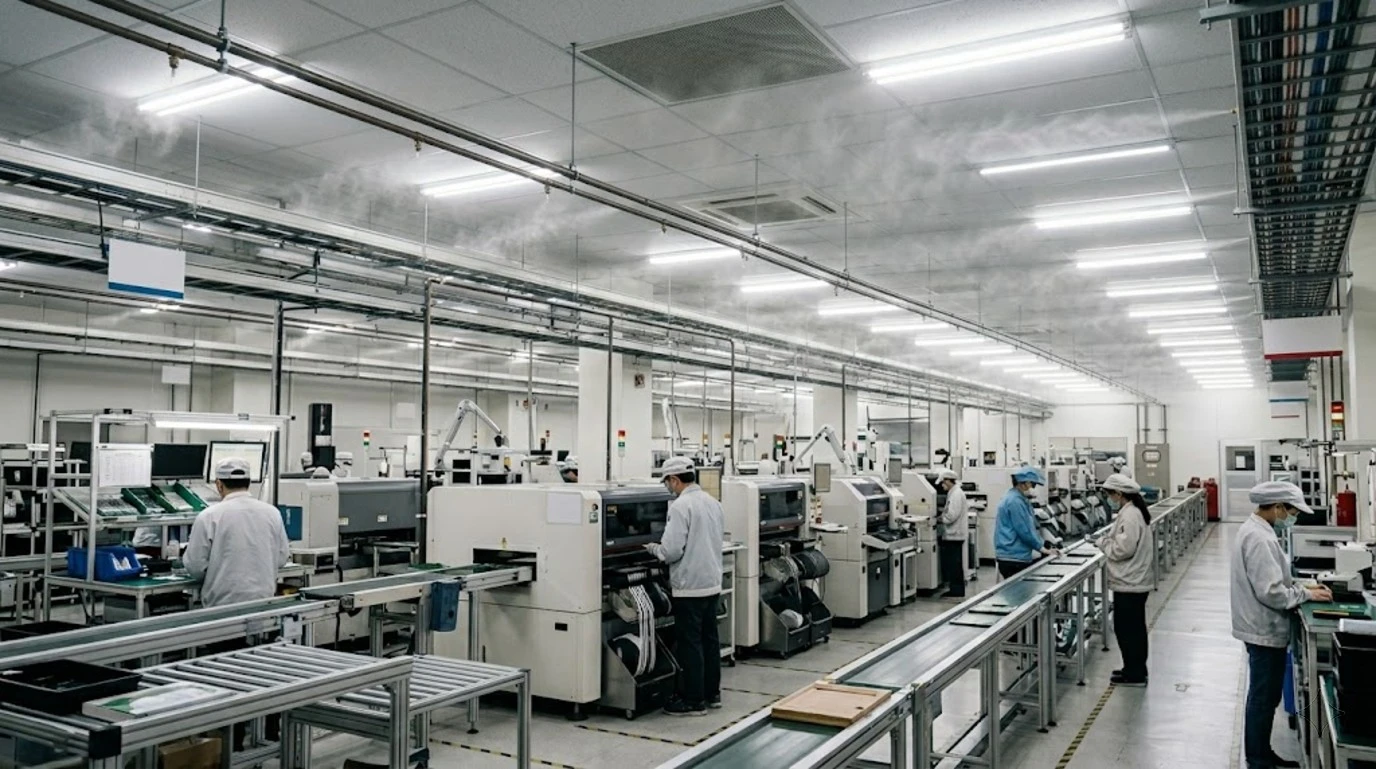
Electronics

Electronics Factory Anti-Static Humidification

Suitable for semi-clean and precision assembly environments.

FAQ

Can dust control engineering help reduce inspection risks?
By stabilizing dust and odor levels, the system reduces the chance of exceedances and helps maintain compliant operating conditions.
Will odor improvement affect on-site production workflows?
Design prioritizes non-interference. Layouts are planned around on-site operating conditions so production rhythm is maintained.
Is it suitable for high-temperature or semi-outdoor industrial spaces?
The system can be tuned to heat sources and airflow conditions, and works in hot, windy, or semi-outdoor structures.
How is performance evaluated?
Evaluate using dust concentration, odor intensity, and on-site feedback; continuous monitoring can also be established.
Can operating modes be adjusted by season?
Yes. Operating strategies can be configured based on climate and operational needs to maintain stable results year-round.